Angkor Wat Black and White
Angkor Wat Black and White
by Jacqueline LaRocca
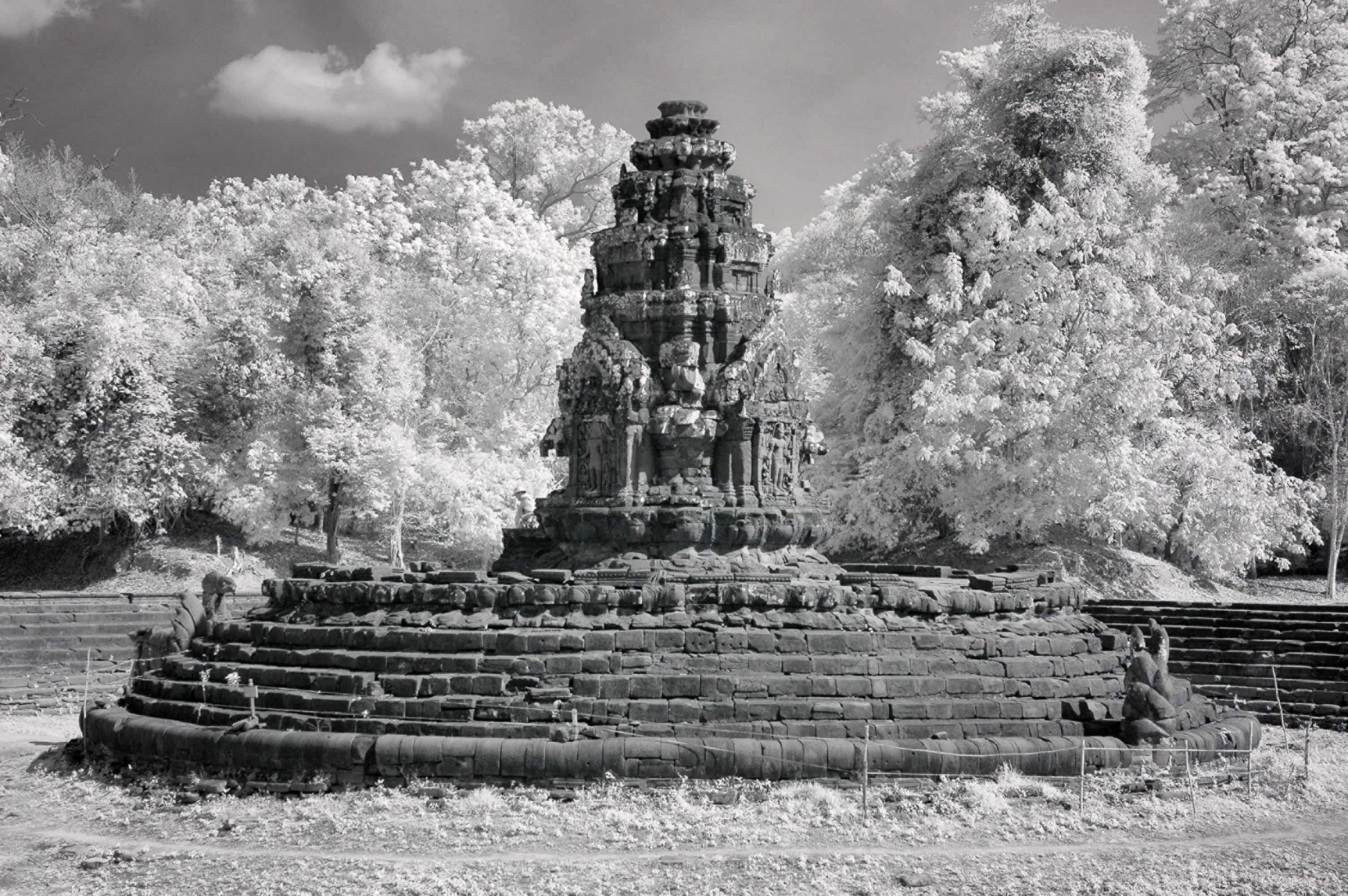
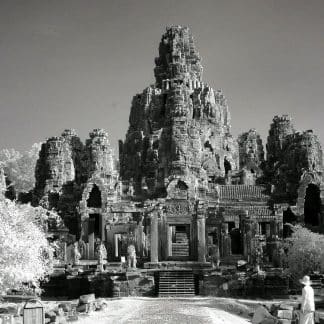
This fine art photograph captures a circular stone temple rising from a tiered base, surrounded by bright foliage. Intricate carvings and statues adorn the central tower, creating a rich architectural profile.
Photographed with an infrared‑influenced technique, the luminous trees contrast with the dark stone, giving the scene a surreal, dreamlike quality.
This artwork stands out for its combination of ancient architecture and ethereal infrared tones.
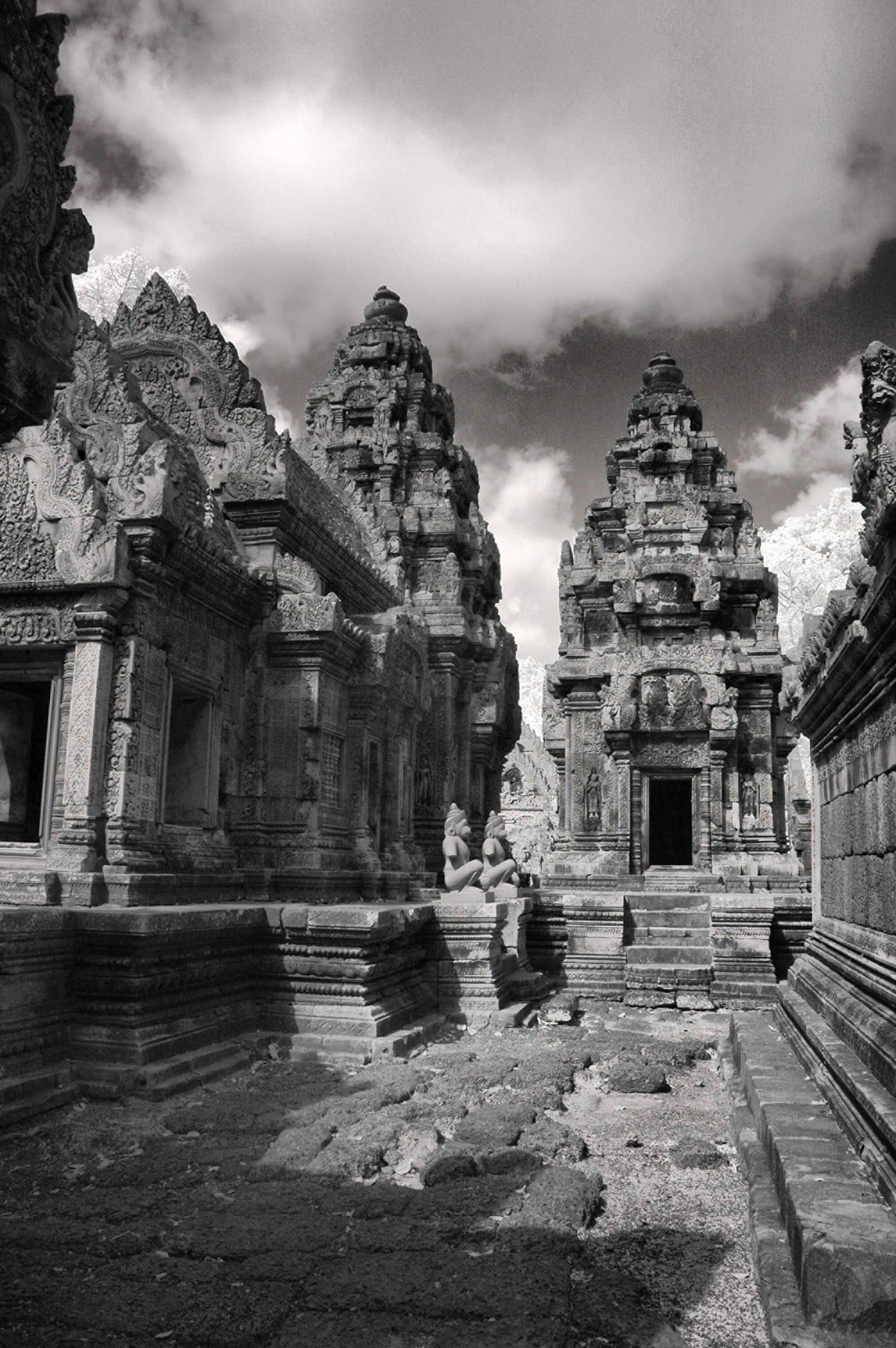
This photograph captures an ornate Cambodian temple entrance flanked by two seated guardian statues. Intricate carvings, sculpted reliefs, and weathered stone surfaces define the scene, showcasing the artistry of ancient Khmer architecture.
Rendered in a fine art monochrome style, the image emphasizes texture, shadow, and the depth of the carvings. The dramatic sky adds contrast and enhances the temple’s imposing presence.
This artwork stands out for its focus on sculptural detail and the serene expressions of the guardian figures.
History of Angkor Wat
Origins and Early Construction
Angkor Wat began rising in the early 12th century under Suryavarman II.
He sought a grand temple that displayed royal power.
Therefore, he dedicated it to Vishnu instead of Shiva.
This choice signaled a major political shift.
Construction likely started around 1113 and continued for decades.
Workers carved sandstone blocks with remarkable precision.
Meanwhile, engineers designed complex foundations to support heavy towers.
Consequently, Angkor Wat soon became the world’s largest religious monument.
Its scale reflected both devotion and imperial ambition.
Symbolism and Architectural Vision
Angkor Wat followed strict cosmic symbolism.
Its central towers represented Mount Meru, home of Hindu gods.
Surrounding galleries symbolized earthly realms and cosmic oceans.
Therefore, movement through the temple mirrored spiritual ascent.
Long corridors guided visitors toward higher sanctuaries.
Meanwhile, the vast moat emphasized sacred separation.
The temple also faced west, linked to Vishnu.
This orientation suggested funerary associations for Suryavarman II.
As a result, Angkor Wat blended religion, astronomy, and royal ideology.
Artistic Mastery and Bas‑Reliefs
Angkor Wat contains extraordinary bas‑reliefs.
Artists carved long narrative panels along the outer galleries.
These panels depicted scenes from the Ramayana and Mahabharata.
They also portrayed historical battles and royal ceremonies.
Consequently, the temple preserved both mythic and political memory.
Figures moved with rhythmic energy across the stone.
Meanwhile, delicate details revealed exceptional artistic skill.
Therefore, Angkor Wat became a masterpiece of Khmer art.
Its carvings still inspire admiration worldwide.
Religious Change and Continued Use
After Suryavarman II’s death, the temple remained significant.
However, the Khmer Empire gradually embraced Buddhism.
Monks adapted Angkor Wat for Buddhist worship.
They added statues, shrines, and ritual spaces.
Even so, the Hindu imagery remained largely intact.
Therefore, Angkor Wat reflected Cambodia’s evolving spiritual identity.
This continuity ensured the temple’s long survival.
Meanwhile, pilgrims continued visiting the sacred site.
Decline, Survival, and Rediscovery
The Khmer Empire weakened during the 14th and 15th centuries.
Political instability reduced support for Angkor.
Even so, monks continued maintaining the temple.
Nature slowly reclaimed surrounding structures.
However, Angkor Wat stayed unusually well preserved.
European explorers documented the site in the 19th century.
Their reports renewed global interest in Khmer civilization.
Consequently, Angkor Wat entered the world’s cultural imagination.
Angkor Wat Today
Today, Angkor Wat stands as Cambodia’s national symbol.
Its towers appear on the national flag and currency.
Meanwhile, millions of visitors explore its galleries each year.
As a result, Angkor Wat remains a monument of creativity, resilience, and devotion.
Showing all 3 results
-
Cambodia Canvas Art Prints
$229.00 (price_excluding_tax) Select options This product has multiple variants. The options may be chosen on the product page -
Cambodia Fine Art Prints
Price range: $190.00 through $350.00 (price_excluding_tax) Select options This product has multiple variants. The options may be chosen on the product page -
Cambodia Framed Art Prints
$550.00 (price_excluding_tax) Select options This product has multiple variants. The options may be chosen on the product page


Showing all 3 results