Washington DC
Washington DC
The Journey of the Korean War Veterans Memorial
Confirmation and Design
In 1986, the U.S. Congress confirmed the Korean War Veterans Memorial. The Korean War Veterans Memorial Advisory Board and the American Battle Monuments Commission managed the design and construction. Initially, a team from The Pennsylvania State University won the design competition. However, they withdrew due to necessary changes. Cooper-Lecky Architects eventually took over the design.
Groundbreaking and Construction
On June 14, 1992, President George H. W. Bush conducted the groundbreaking. This marked the start of construction. Several companies were involved in the construction.
Dedication and Management
President Bill Clinton and Kim Young Sam, the South Korean president dedicated the memorial on July 27, 1995. After the dedication, the National Park Service took over the management. The memorial was listed on the National Register of Historic Places on the day of its dedication.
The Column
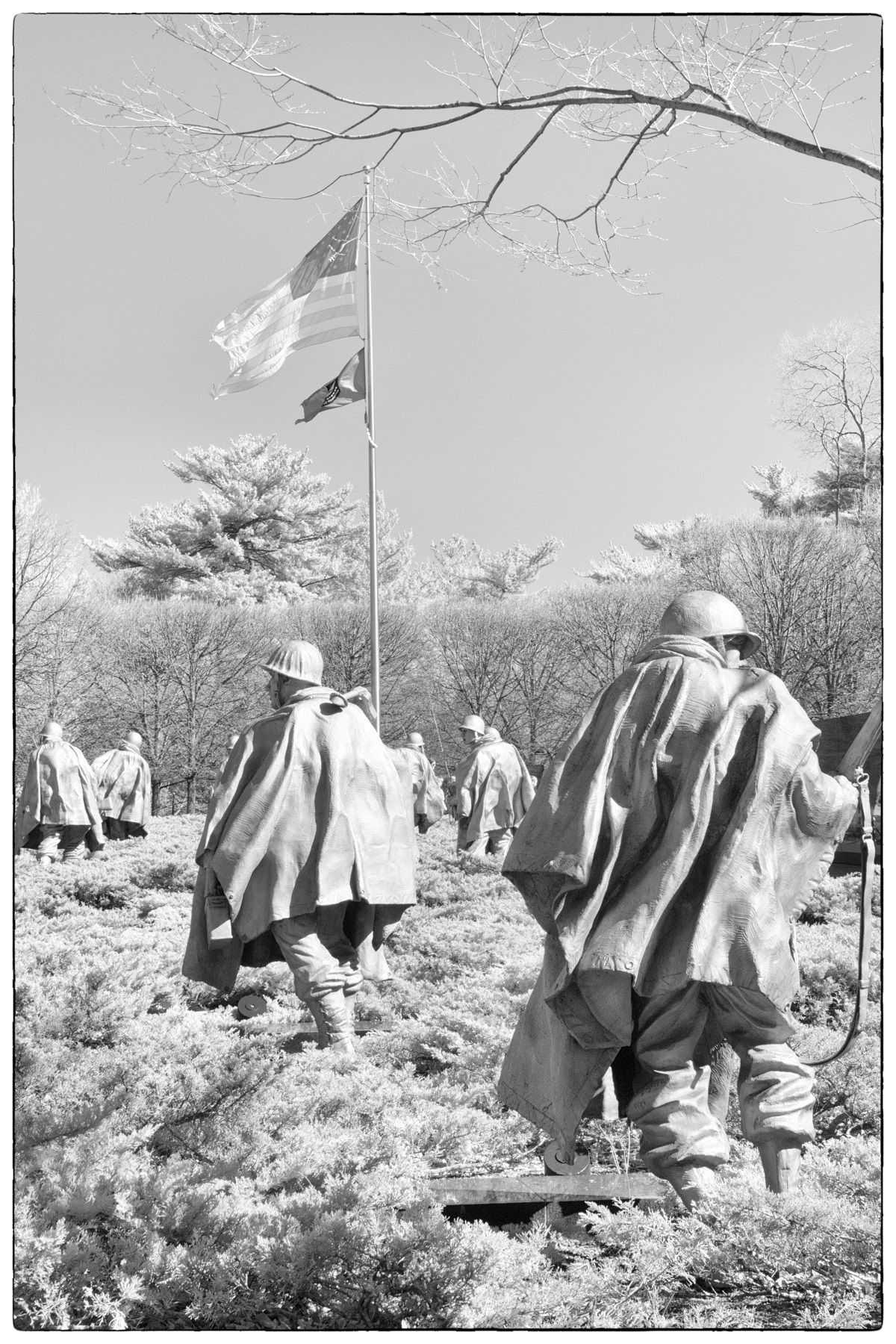
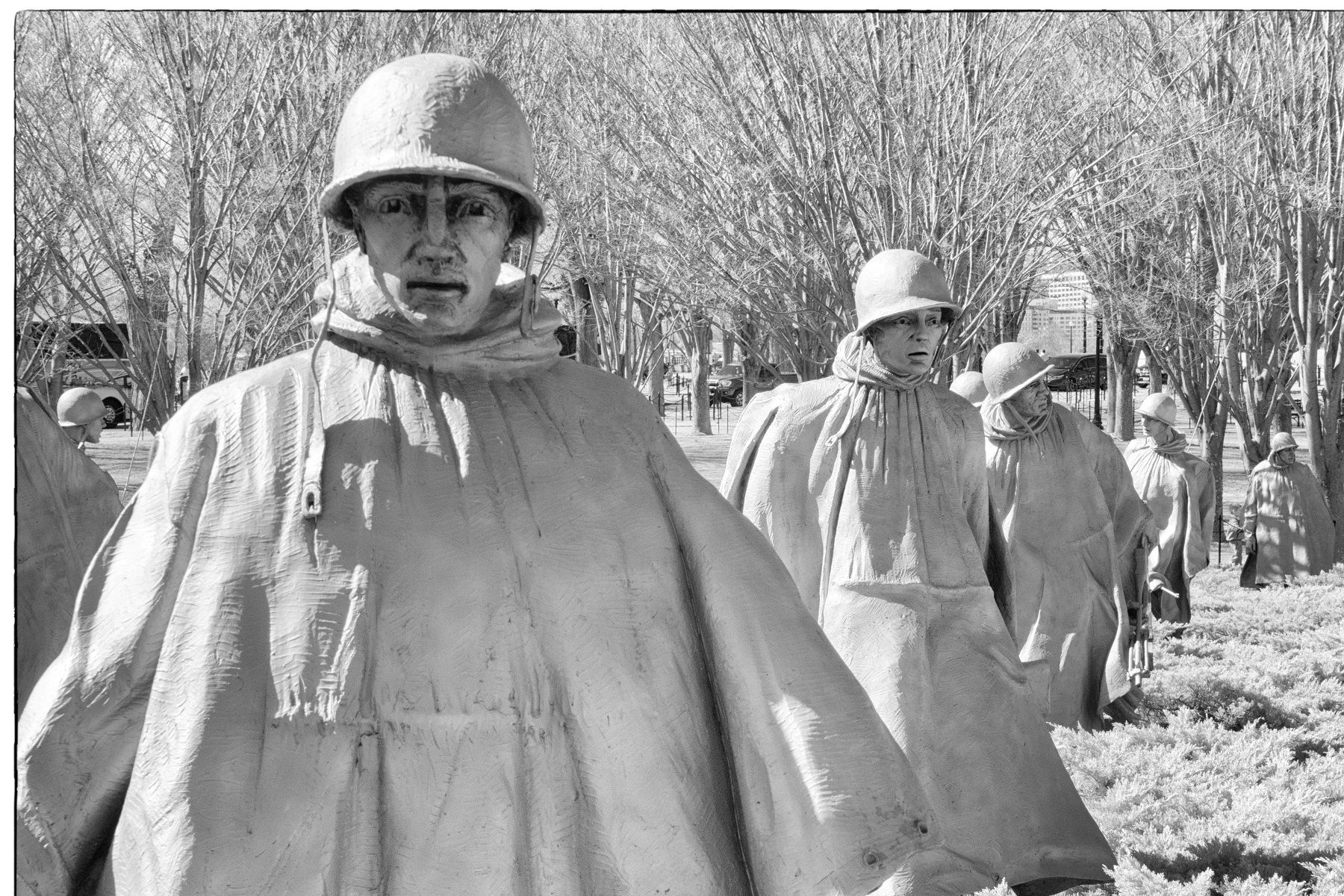
Within the walled triangle, 19 stainless steel statues stand tall, designed by Frank Gaylord and known collectively as The Column. Each statue, larger than life-size, measures between 7 feet 3 inches and 7 feet 6 inches tall and weighs nearly 1,000 pounds.
These figures symbolize a platoon on patrol, drawn from various branches of the armed forces.
Fourteen figures represent the U.S. Army, three symbolize the Marine Corps, one embodies a Navy Corpsman, and one signifies an Air Force Forward Air Observer.
Dressed in full combat gear, they are dispersed among strips of granite and juniper bushes, representing the rugged terrain of Korea.
The Korean War
The Korean War erupted on June 25, 1950, when North Korean forces, backed by the Soviet Union and China, launched a surprise invasion of South Korea. Almost immediately, South Korea, also supported by the United Nations—primarily the United States—rushed to defend its territory. As the fighting intensified, American troops joined the battle, determined to push the North Koreans back.
American Troop Join War
Quickly, the war turned into a dramatic series of advances and retreats. Initially, North Korean forces drove deep into South Korea, nearly overtaking the entire peninsula. However, General Douglas MacArthur orchestrated a daring counterattack with the Inchon Landing in September 1950, swiftly reclaiming lost territory. As U.N. forces surged forward, they advanced beyond the 38th parallel into North Korea, threatening the Chinese border. Alarmed by this development, China intervened, sending massive reinforcements that overwhelmed U.N. troops and forced them into retreat.
Stalemate
The war soon reached a frustrating stalemate. Both sides struggled for control, especially around the rugged terrain near the 38th parallel. Over the next two years, fierce battles raged while peace talks dragged on. Finally, after countless negotiations, both sides signed an armistice on July 27, 1953, bringing active combat to an end. Although the fighting ceased, the war never officially concluded with a peace treaty, leaving North and South Korea divided to this day.
Aftermath
Even decades later, the Korean War remains a critical event in global history. It shaped Cold War tensions, deepened U.S.-China rivalries, and solidified the divide between North and South Korea. While the battlefields grew silent, the conflict’s impact continues to influence geopolitics around the world.
Showing all 5 results
-

DC Fine Art Prints
$229.00 (price_excluding_tax) Select options This product has multiple variants. The options may be chosen on the product page -
District of Columbia Canvas Prints
$229.00 (price_excluding_tax) Select options This product has multiple variants. The options may be chosen on the product page -

District of Columbia Framed Prints
$550.00 (price_excluding_tax) Select options This product has multiple variants. The options may be chosen on the product page -

Washington DC Memorial Day Framed Prints
$550.00 (price_excluding_tax) Select options This product has multiple variants. The options may be chosen on the product page -
Washington DC Memorial Day Photography
Price range: $190.00 through $350.00 (price_excluding_tax) Select options This product has multiple variants. The options may be chosen on the product page


Showing all 5 results