Cambodia Fine Art Prints
Cambodia Fine Art Prints
by Jacqueline LaRocca


History of Cambodia
Cambodia’s history unfolds over millennia, revealing a civilization that rose, transformed, and endured.
It began with early settlements along the Mekong River. Neolithic communities cultivated rice and developed sophisticated pottery.
Eventually, by the 1st century CE, the powerful kingdom of Funan emerged. Funan thrived through maritime trade and Indian cultural influences.
6th Century
Then, Chenla succeeded Funan in the 6th century, laying the groundwork for an even more remarkable empire.
9th Century
By the 9th century, the Khmer Empire rose to dominance, marking Cambodia’s golden age. Under rulers like Jayavarman II and Suryavarman II, the Khmer expanded their territory and constructed awe-inspiring temples.
Angkor Wat
Most notably, they built Angkor Wat, which still stands as the world’s largest religious monument. Because of advanced hydraulic engineering, the empire sustained massive urban populations for centuries.
15th Century
However, by the 15th century, internal strife and foreign invasions weakened the Khmer Empire, leading to Angkor’s eventual abandonment.
19th Century
Afterward, Cambodia became a vassal state under Thai and Vietnamese control. In the 19th century, French colonization incorporated Cambodia into French Indochina.
Independence
Then, in 1953, Cambodia gained independence under King Norodom Sihanouk.
Khmer Rouge
The late 20th century brought tragedy. Between 1975 and 1979, the Khmer Rouge, led by Pol Pot, orchestrated a brutal regime that caused the deaths of nearly two million people.
Consequently, Vietnam intervened, overthrowing the Khmer Rouge in 1979. Despite lingering civil war, Cambodia gradually stabilized in the 1990s with the help of United Nations peacekeeping efforts.
Monarchy
Eventually, a constitutional monarchy took shape, with Norodom Sihanouk returning as king.
Today, Cambodia continues to recover and rebuild. Although the trauma of its past remains, the country embraces both resilience and renewal.
Temples
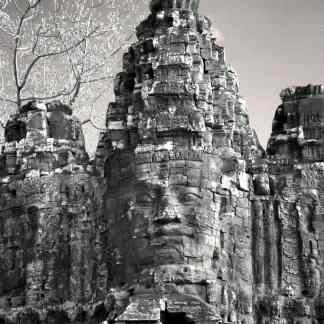
Temples like Angkor Thom and Bayon echo its imperial legacy, while vibrant cities like Phnom Penh reflect a modern, forward-looking nation.
Through centuries of glory, colonization, and survival, Cambodia has emerged as a land of deep spirit and enduring culture.
Geography of Cambodia
If you like Cambodia Fine Art Prints, you may also like
Showing all 3 resultsSorted by latest
-

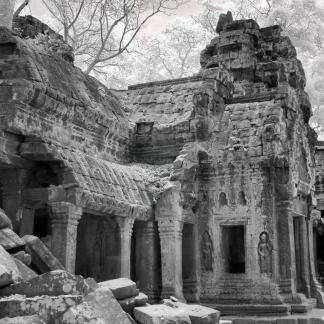
Ta Prohm Black & White Photos
Price range: $190.00 through $550.00 (price_excluding_tax) Select options This product has multiple variants. The options may be chosen on the product page -
Angkor Thom Black & White Photos
Price range: $190.00 through $550.00 (price_excluding_tax) Select options This product has multiple variants. The options may be chosen on the product page -
Angkor Wat Black and White Photos
Price range: $190.00 through $550.00 (price_excluding_tax) Select options This product has multiple variants. The options may be chosen on the product page

Showing all 3 resultsSorted by latest